Last week I whined about losing weight the difficult way. Extreme weight loss programs work – if you stick with them - for a lifetime. But who does that? I’m guessing one percent of the population!
That means I have to revert back to the tried-and-true way; exercise and calorie intake while making smart choices. Eating isn’t rocket science. Let’s talk about the lowly salad. A salad doesn’t have to be boring. To begin with, there’s a myriad of lettuces to choose from and they all come packed with vitamins and minerals. My favorites are spinach, kale, endive, romaine and beet greens when I buy beets. I seldom use iceberg and only for the crunch because there are so many others that pack more nutrients.
Top off those great greens with veggies such as radishes, tomatoes, shredded carrots, cucumbers, crumbled cauliflower, and protein rich beans, olives and goat or feta cheese and boom, you have a filling nutritious meal that will stick with you.
If you’re not into salads, those same greens can be a flavorful addition to dishes or they can take center stage.
Spinach is a mainstay of nearly all my smoothies. Besides fiber and vitamins, spinach has folate which helps convert food into energy. Looking for a great homemade snack? Tear big pieces of kale and toss with a little olive oil and salt and bake in the oven at 350 till crispy. I add garlic powder to mine only because I love garlic. Boston or butterhead lettuce has a velvety texture and the whole leaves can be turned into vessels for a potpourri of fillings. Same with endive make little ‘boats’ for fillings or dips.
If you rank salad greens from best to last, Kale is number one. It’s packed with vitamins A, C and K and calcium. Unfortunately, it can taste bitter to some people so add it to a salad or bake up some of those chips to see if you like it. You might guess what is at the bottom of the list. If you guessed iceberg you were right. Iceberg doesn’t offer a lot since it’s low nutritional value so I add iceberg just for the crunch.
One thing I haven’t tried is Swiss Chard. I didn’t realize that until I started writing this column. It’s easy to find and the stalks can come in yellow, reddish purple and white. My imagination is running wild! Lett-use eat!
Your feedback is always welcome. Readers are encouraged to email us at news@kingstreenews.com or write with your feedback, ideas, or questions.
Sushi Pier’s Mr. Pink is this week’s featured EAT dish. Rob Galloway / Tahoe Daily Tribune
To try and decide each week where and what to eat around the basin can be a challenge — there are so many amazing choices. In this feature we’ll dive into dishes that will surely satisfy those hunger pangs and leave you wondering where to go next.
Anytime you can create a dish that has me reminiscing about one of the best movies in Quentin Tarantino’s catalog, you have me at hello. I’ll try to refrain from the “Reservoir Dog” references here, but in the case of this roll, it not only barks, it also bites. OK, lame reference. I get it. I’ll stick to the food.
On that note, good sushi coming out of the kitchen should always give you a little pause so you can soak in the presentation. This roll does that. It stands tall in the pocket with colors popping off left and right. It’s so visually appealing you almost don’t want to eat it. Almost. Who am I kidding? Not even almost – I want to dive right in.
The roll itself rides in with crystal shrimp and cream cheese. It’s layered with a duo of seared tuna and avocado then topped with crap, green onion, and unagi.
I’m a sucker for unagi. That thick and sweetened soy sauce could be thrown down on a slip and slide and I’d have no problem deciding what to do on a Sunday afternoon. Here it adds that sweet and salty component to help cut through the creaminess of the cream cheese and avocado.
The tuna and crab play nicely with the crispy shrimp. It’s all super fresh and light, but packed with flavor. Tack on the ever so slight texture from the green onions and you’ll be happy they offer up an all you can eat option.
And if you’ve ever listened to a K-Billy’s Super Sounds of the Seventies weekend, you might want to pair it with one or two of these rolls to help you keep on truckin’. They should go hand in hand. Much better than my second attempt at a movie reference.
Sushi Pier is located at 177 U.S. Highway 50 in Stateline. For general information and menu items visit them online at tahoesushipier.com or via phone at 775-588-8588.
Readers around the Lake Tahoe Basin and beyond make the Tahoe Tribune's work possible. Your financial contribution supports our efforts to deliver quality, locally relevant journalism.
Now more than ever, your support is critical to help us keep our community informed about the evolving coronavirus pandemic and the impact it is having locally. Every contribution, however large or small, will make a difference.
Your donation will help us continue to cover COVID-19 and our other vital local news.
My mother never cared for cheap Easter candy, but she loved to eat the dyed eggs. As a child, this shocked and perplexed me, and not just because I preferred chocolate. It simply did not seem sanitary to me, the child who had found the eggs and picked them up with her sticky little child hands. But Easter eggs can be safe to consume, as long as you time it right.
Advertisement
The window for eating a room-temperature hard-boiled egg is two hours, which leaves you plenty of time to decorate—but people don’t usually boil eggs, decorate them, and immediately hide and hunt for them. At least in my childhood home, eggs were cooked and decorated the day before, then stored in the fridge until Easter morning, at which point my parents would hide them.
This is where things get a little complicated. According to the USDA, the safety of the eggs hinges on where you hide them, how quickly they’re found, and how gently they’re handled:
Hunting Eggs: We do not recommend using hard cooked eggs that have been lying on the ground, because they can pick up bacteria, especially if the shells are cracked. If the shells crack, bacteria could contaminate the inside. Eggs should be hidden in places that are protected from dirt, moisture, pets, and other sources of bacteria. The total time for hiding and hunting eggs should not exceed 2 hours. The “found” eggs must be washed, re-refrigerated and eaten within 7 days of cooking.
In addition to hiding eggs in fairly clean spots, washing them, and discarding any that are cracked, make sure you use a food-safe dye—or use actual food to dye them—if you plan to snack on the found eggs. Or you can just use those plastic eggs, put candy inside them, and eat the candy instead. You’ve got a lot of good options, is what I’m saying.
Whether they're in a smoothie, a pastry, or any other recipe they can be added to, berries are a delicious, and nutritious fruit choice. There are many benefits to eating berries, including weight loss, as berries are high in fiber and phytonutrients. These act as "antioxidants in the body," especially blueberries, according to Lisa Richards, a nutritionist with The Candida Diet. Richards added that strawberries in particular are packed with vitamin C, which helps to improve the immune system.
While there are many upsides to consuming berries, there is also one major side effect that eaters, especially with diabetes, should be aware of when choosing the delicious fruit for a snack. When you eat too many berries, the fruit can result in abnormally lower blood glucose.
Here's what you need to know about berries and blood sugar levels, and for even more healthy eating tips, be sure to check out our list of The 7 Healthiest Foods to Eat Right Now.
Personal trainer Ben Rose, a co-founder of Trainer Academy, said that berries might not "be good news for diabetics."
In addition to potentially lowering blood glucose to an abnormal level, "Berries also have a vital effect in reducing blood sugar and increasing insulin sensitivity," says Rose. "They reduce the blood glucose spike after a carb-rich meal by blocking the function of some digestive enzymes, They can even slow protein digestion."
Lowered blood glucose, or blood sugar, can lead to a feeling of shakiness, confusion, and increased heartbeat. And even in some cases, seizures, when the blood glucose levels get too low.
How can you fix this?
An easy fix is to moderate your berry intake. Instead of over-indulging and messing with your blood glucose, follow the proper serving sizes for this sweet fruit. A typical serving size of berries is about one cup.
If you think you have low blood sugar, a simple solution is to take in 15 grams of carbohydrates to raise your blood sugar, according to the American Diabetes Association.
Rose also recommends speaking with a doctor, especially for diabetes patients, to consult whether you should consume berries and what a personalized recommended serving size would be.
America’s favorite pastime: making bold claims about sports on the internet, and then declining to follow up on those assurances if or when they don’t come true.
But here at SwimSwam, we have a special respect for people who are willing to be held to account for their flaming hot (or ice cold) takes.
One such take was levied by “Willswim,” as part of a debate related to the impending battle between college stars Maggie MacNeil and Kate Douglass, and whether Douglass would leave the meet with any wins at all.
After “ALEXANDER POP-OFF” proposed (but did not declare) the possibility of the Virginia sophomore Douglass leaving the meet “without any wins,” “Willswim” thought he would lob a pedantic response about individual wins, assured of what seemed like a softball proposal that Douglass would almost surely win a relay, given that the Cavaliers were entering the meet with the top seed in all 5 of them and were NCAA Record breakers in the 200 medley at the ACC Championships.
In fact, Virginia did win a relay, though it was the 800 free relay that they won. Douglass wasn’t on that relay.
And in fact, Douglass did come away with an individual event win, in the 50 free, though MacNeil did come out on top in both the 100 fly and 100 free.
And of course they both missed the most obvious “win” that Douglass came away with from the meet: the NCAA team championship, the first in Virginia’s history.
But where Willswim veered way off course was accompanying his confidence about the outcome with a penance. It was a penance he thought he might never have to ante up, but it was a penance to eat his goggles. Not the more palatable “I’ll eat my shorts” (would edible underwear count?) or even “I’ll eat my hat” (I think I could choke down a bite or two of one of those straw hats, if roasted over an open fire).
Nobody ever guarantees that they’ll “eat their ice cream” or at least “eat their lima beans” if they’re wrong.
But Willswim went with goggles. Pure plastic and indigestible silicon.
But Willswim, in spite of not perhaps being a brilliant prognostiactor of swimming (he placed just 194th in the women’s NCAA Pick ‘Em Contest), is a man of his word.
While he couldn’t stomach, literally, the thought of actually trying to eat an entire pair of goggles, he made an effort worth lauding.
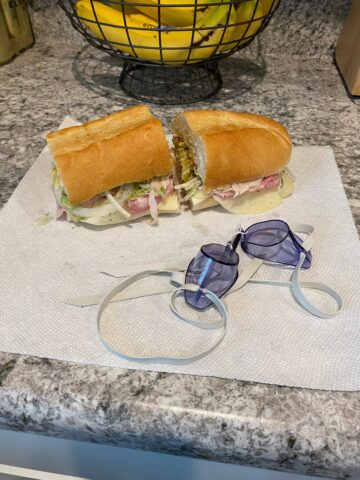
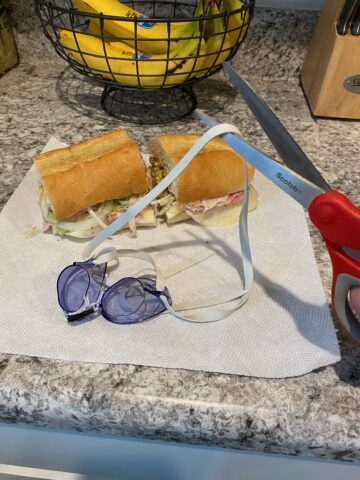
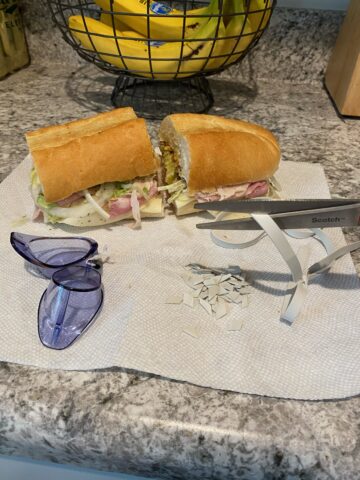
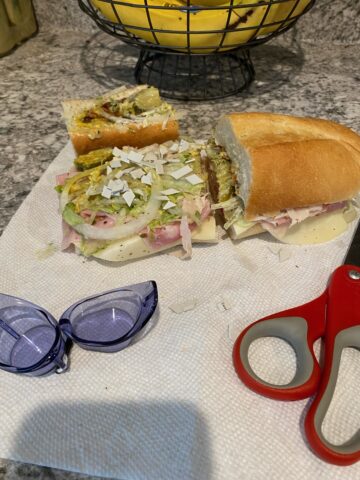
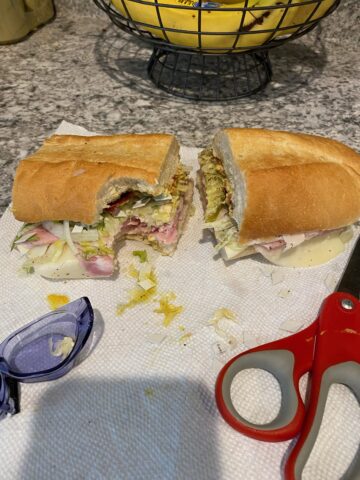
Sacrificing a pair of Swedes to the SwimGods, WillSwim put a bite of strap into his sandwich, and chowed down. While perhaps not a complete ingestion of a pair of goggles, the effort has absolved him of his transgressions, freeing him without heavy conscience to declare a future certainty.
For future reference, we do accept donations to your favorite swim charity instead of actually eating an article of clothing. Here’s a list of suggested charities. Don’t eat your goggles.
Below, read Willswim’s letter of apology, and some pictures of the deed.
Dear Mr(s). SwimSwam,
Hi! I’m the guy who stupidly boasted that he’d “eat his goggles” if Kate Douglass wasn’t on a winning relay at NCAAs this year. As you know, she wasn’t. I don’t know if I was overexcited about a tremendously talented young swimmer on the best team, if I was trying to amuse or gain favor with the SwimSwam commentariat (that’s a thing), if I just have too much chlorine in my brain, or if it’s a combination of all those things, but it doesn’t matter. I said what I said and now here we are.
I believe there is no greater coward than a liar. I was an average-to-below-average D3 swimmer in the late 90’s, so obviously, my opinions in the SwimSwam comment section hold A LOT of weight with the swimming community worldwide. I can’t have the honorable name Willswim besmirched! That’s why I think it’s important that I hold up my end of this nonsense accord I made with no one in particular. How hard could it be? Rumor has it that Joseph Schooling regularly eats four or five pairs of goggles a day IN PRACTICE!
I chose a pair of Swedes. Ultimately, I couldn’t figure out a way to eat the hard plastic lenses without potentially lacerating my bowels so I abandoned that idea and decided to only eat the rubber strap. I don’t know what rules karma and the SwimGods (Dean!!!) will use to judge me, but my hope is that even though I wasn’t eating the entirety of my googles, they would look kindly on my attempt.
My plan was to cut the strap into little pieces and put them on a sandwich. I was hoping the sandwich would be both substantial enough and flavorful enough to mask the rubber. It wasn’t. I took one bite and unchewable rubber was the most obvious thing in my mouth! Quickly I realized the rubber pieces I’d cut were way too big and this was going to be a more difficult and unpleasant experience than I’d anticipated.
I was able to swallow two pieces of rubber goggle strap before I gave up and removed the remaining athletic wear from the remainder of my meal. I could not do what I had promised and begrudgingly accepted that my comeuppance would be the second difficult thing I had to swallow that day.
I did consume a small portion of my goggles, but probably not enough to think I’d still be welcome on a pool deck ever again. Sadly, in the end I failed and didn’t eat all of my goggles. My deepest apologies go out to SwimSwam, the SwimSwam commenters, Kate Douglass, Todd DeSorbo, Mel Stewart, my parents, sandwich eaters, Sweden, and all other legends of the swim.
Diet is now ranked as leading cause of death in the United States, ahead of tobacco use and high blood pressure.
We’ve all been told about the benefits of a healthy diet. What is generally less well-known is just how risky poor nutrition can be.
Heart disease continues to be the leading cause of death in the United States ahead of tobacco use and high blood pressure year are:
Cardiovascular diseases, including coronary artery disease, high blood pressure and stroke
Obesity, and by extension diabetes, increased cancer risk and joint pain, to name just a few
Cognitive decline, such as dementia and Alzheimer’s disease
Increased cancer risk
“These are some of the most common causes of illness and death in the country and minority communities are disproportionately affected,” said Lira. “In our practice, nearly every patient suffers from at least one of these conditions.”
Research has shown diet also plays a role in other common conditions including lung disease, depression, anxiety, autoimmune diseases and autoinflammatory conditions.
Eat This, Not That
Lira says there are six major offenders that pose the greatest dietary risks. Below, she offers some switches you can make to improve your diet and eating habits:
Processed foods – Be aware that chips, crackers, packaged meats, TV dinners and soups tend to be high in salt (sodium), trans and saturated fats, and. sodium
Added sugar – This comes in soda, juice, desserts, cookies, snack cakes, candy, coffee syrups and sweetened creamers, and some breads. You can satisfy your nighttime sweet tooth with some
berries with a small amount of whipped cream.
Far too little plant-based food – Many people struggle to eat the recommended daily amount of
fruits and vegetables. Keep cut veggies handy for a quick snack or lunch box addition. Turn an omelet or other eggs into a meal by stirring in a mixture of veggies, such as carrots, peppers, onions, mushrooms, or spinach and some low-fat cheddar cheese.
Unbalanced meals – Each plate of food we eat should be made up of vegetables and then some of each food group including protein and healthy carbohydrates, such as whole grains.
Too little fiber – We all need more fiber in our diet from sources like beans, peas, fruits, vegetables and whole grains. Fiber aids digestion, helps you feel fuller longer and can help with blood sugar and cholesterol control.
Skipping meals and excessive snacking – The body needs a ready supply of energy spaced consistently throughout the day. Try to modify your food intake by eating on a regular schedule. Plan your meals and snacks.
“Almost all of the conditions we deal with on a daily basis, no matter what their causes, can be improved by a diet rich in plants, increased physical activity and smoking cessation,” said Lira.