Rechercher dans ce blog

Tuesday, July 27, 2021

What to Eat at the Social, the Brand-New Shop From Ample Hills’ Original Founders - Grub Street

A sundae with homemade doughnuts. Photo: Melissa Hom

As the founders of Ample Hills, Jackie Cuscuna and Brian Smith, know how to open a scoop shop. But this past weekend’s opening of the Social, their new storefront in Prospect Heights, was different: It’s a fresh start and a true second chance after the couple filed for bankruptcy and was forced to sell Ample Hills in 2020. And, in a way, it’s a return to the hands-on approach that made their very first shop such a success. After all, it’s still ice cream, and Smith, ice-cream visionary, is still ice-cream obsessed.

At the Social, all the flavors are original — even the vanilla has gotten a revamp — and many of them incorporate Smith’s newfound passion for blending. “I have a Vitamix at home, and I just started trying stuff,” Smith explains. “I was like, ‘Oh my God, this can pulverize anything.’ It opened up a whole new world.” Soon, he was whizzing monkey bread into coffee ice cream and doughnuts into maple ice cream; Morning in Paris features whole fresh croissants blended into the base. The results, he says, were “mind-boggling” — perfectly smooth but with body and bite.

Call it “new, but familiar,” a description that might apply to the Social in general, a just-opened shop from people who know the neighborhood, and who are in turn known to anyone with even a passing interest in ice cream. But this is still a new shop, with a new menu (doughnuts!), and new flavors, and Grub Street stopped in last week to sample (almost) everything on the menu. Here, a look at what you can expect when you swing into the Social at some point this summer.

Photo: Melissa Hom

Chocolate Fudge
An all-encompassing chocolate experience. It is like being lost in a chocolate forest. It is like drowning in a chocolate sea. It is overwhelmingly smooth but with body and chew. Not for chocolate lightweights.

Photo: Melissa Hom

Cocoa Mallow Pop
At Ample Hills, Smith made Snap Mallow Pop — a marshmallow-flavored ice cream with Rice Krispies mixed in, like an inverted Rice Krispie treat. But the Rice Krispies, back then, had always gotten a little bit soggy, which, at the Social, could no longer stand. It’s still triumphantly fluffy marshmallow ice cream, but this time, Smith coats the Krispies with a cocoa-and-coconut-oil shell to preserve the crunch.

Photo: Melissa Hom

Go Go Bananas
An old-time classic, banana ice cream has fallen out of favor in recent years. This is our collective mistake, which the Social aims to correct. Smith’s version is fruity — distinctly banana but not oppressively banana — and unexpectedly nuanced, the Platonic ideal of banananess, only much creamier. “At Ample Hills, everything had mix-ins,” he says, “but here, I wanted to have a number of flavors that were just pure so that people could pair them with each other.”

Photo: Melissa Hom

Orange Dreamsicle
You might think you don’t remember exactly what orange sherbet tastes like, but you do. It is this. “It’s a flavor that was on every Howard Johnson’s menu in the ’70s,” says Smith, who set out to capture the flavor “the way you remember from childhood,” only using real juice from actual oranges. The precision is uncanny.

Photo: Melissa Hom

Peanut Butter Double Dutch Fudge
The name does not lie: This is peanut-butter ice cream — mellow but profound — studded with chunks of peanut butter and chocolate fudge.

Photo: Melissa Hom

Mint Chocolate Flake
If Smith’s ice creams have a trademark, it is perhaps their ease: They are easy to like and easy to eat, agreeable and comforting, like golden retrievers. There is, perhaps, no better example than his latest take on mint chocolate chip, which is gentle and well balanced, like a mint-chocolate hug.

Photo: Melissa Hom

Double the Dough
“If you have an ice-cream shop, you have to have a cookie-dough flavor,” Smith explains reasonably. Most cookie dough is vanilla ice cream with occasional dough gobs — a brilliant innovation, he agrees, but no longer enough. “How do you take it to the next level?” he wondered. The answer was: Blend it. Smith purées plain cookie dough into the ice cream itself, then mixes in great gobs of chocolate chocolate-chip-cookie dough, for a result that is, very literally, double the dough.

Photo: Melissa Hom

Hydrox Cookies & Cream
There was an ice-cream shop at this location before, in the 1940s, and while Cuscuna and Smith are not sure what it was called, they do know one thing from the pictures: It sold Hydrox ice cream. In a nod to both that past and the crunch superiority of Hydrox over Oreos (they tested), Smith mixes substantial cookie chunks into a Hydrox-infused ice-cream base.

Photo: Melissa Hom

Oh Captain, My Captain
Infused with emulsified Cap’n Crunch and studded with clusters of white chocolate-bound Fruity Pebbles, this is cereal with milk, if the milk were ice cream. Nostalgic and sweet, in all senses.

Photo: Melissa Hom

Fudge Crackle
A vegan chocolate with a coconut-milk base and mixed-in Rice Krispies for volume and subtle crunch.

Photo: Melissa Hom

A Cool Breeze
“It’s really trying to be Sprite or 7UP as a sorbet,” Smith explains, only instead of straight lemon and lime, it has a hint — a whisper, if you will — of peppermint extract, to give it “that cool-breeze kind of experience.”
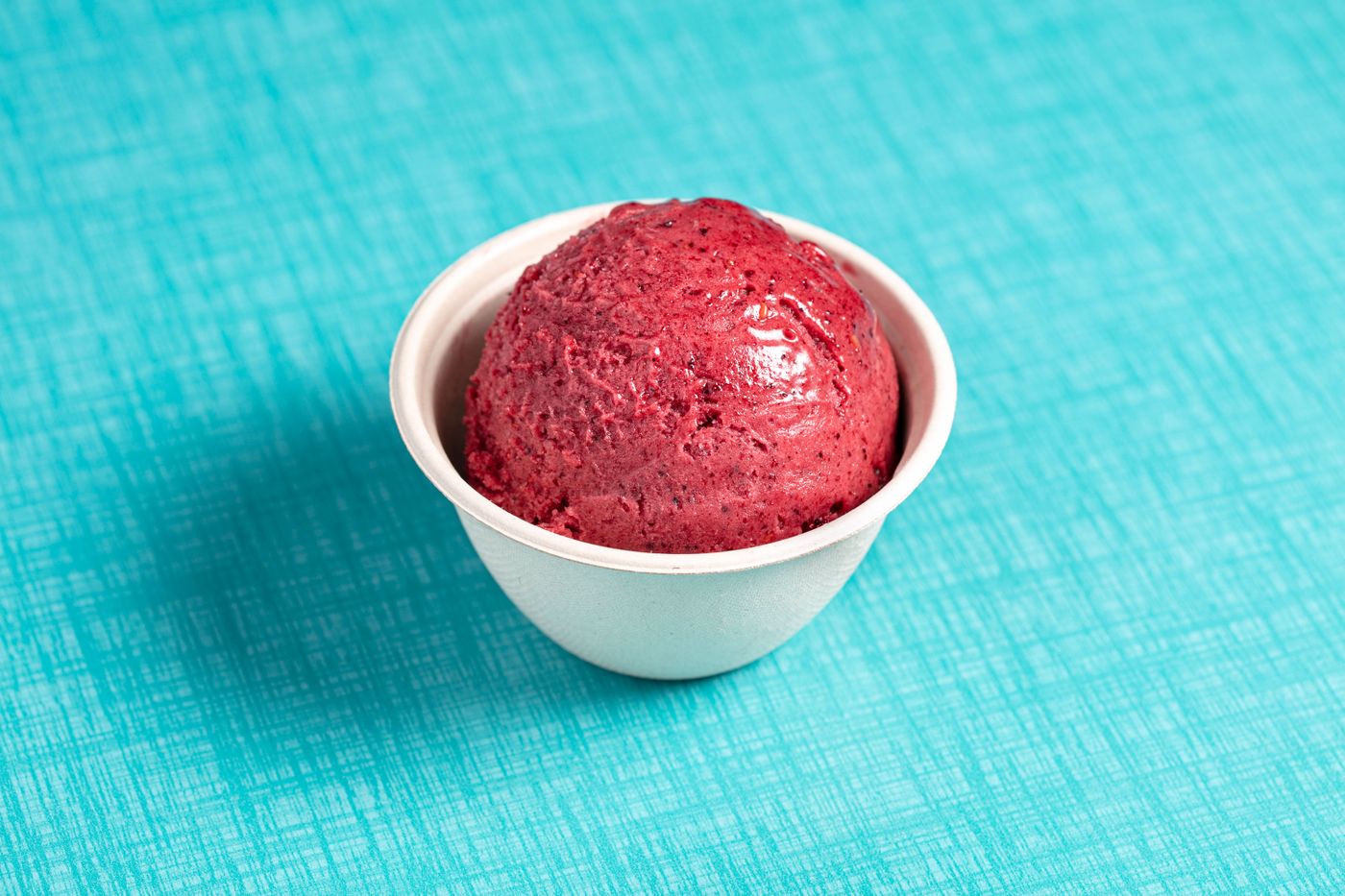
Photo: Melissa Hom

Mix It Up
One of a small handful of nondairy flavors (they’ll rotate), the version you see pictured is a classically summery four-berry sorbet. (The eponymous “mix”: blackberries, blueberries, raspberries, strawberries.)

Photo: Melissa Hom

Old-Fashioned Doughnuts
“I just knew I wanted to do one significant thing that was obviously different from what we’d done at Ample Hills,” Smith says. “Something that was decadent or over the top, that you could pair with ice cream.” That thing is doughnuts. For now, Smith is limiting the menu to four cake varieties: old-fashioned plain, old-fashioned glazed, cinnamon sugar, and “cookies and cream” coated with a sugar–ground-Hydrox blend.

Already, though, there are more in the works: a chocolate doughnut with chocolate glaze (“Fudgetaboutit”), and a Fruity Pebbles–encrusted doughnut with a Cap’n Crunch glaze (“Captain Donut”), with other ice cream-inspired iterations on the way. “Obviously, we’re an ice-cream shop that sells doughnuts, not a doughnut shop that sells ice cream. That’s an important thing for us to remind ourselves so that we don’t get crazy and try to offer 30 different kinds of doughnuts,” Smith says, trailing off, before adding, “I mean, if people start coming here for the doughnuts instead of the ice cream, it’s not necessarily a problem …”

Photo: Melissa Hom

Ice-Cream Sodas
In addition to milkshakes and egg creams, the Social is leaning hard into ice-cream sodas, featuring homemade syrups and homemade whipped cream (vanilla or chocolate) so thick it’s served with a scoop. “It’s more like schlag,” Smith explains. “It’s the Peter Luger experience.” The flavors lean classic: chocolate with cherry soda, or orange with vanilla soda, or — most controversially — orange with chocolate soda, which Smith admits is divisive. “People have a real love-hate with orange and chocolate, but I love the combination,” he declares, noting its rarity. “It’s just like having banana ice cream: You don’t see it very often anymore.”

Photo: Melissa Hom

The Doughnut Sundae
The doughnuts also serve as the base of the Social’s Sundaes, a luxury ice-cream experience featuring two scoops of any ice cream over a warm doughnut (or, should you prefer, butter cake) topped with the schlagish whipped cream and hot fudge, and, if you want, for $2 more, they’ll make it an affogato and bathe whole thing in espresso.

Adblock test (Why?)


What to Eat at the Social, the Brand-New Shop From Ample Hills’ Original Founders - Grub Street
Read More

Monday, July 26, 2021

Mission impossible or possible: Can you eat healthy at the fair? - Banner Graphic

[unable to retrieve full-text content]

Mission impossible or possible: Can you eat healthy at the fair?  Banner Graphic
Mission impossible or possible: Can you eat healthy at the fair? - Banner Graphic
Read More

The future of food: Can you eat to save the climate? - World Economic Forum

  • There's a growing interest in climate-friendly foods, but consumers find it hard to know if the food choices they make are environmentally sustainable;
  • From ready-made snacks to algae, cacti and grains, options for climate beneficial foods are increasing;
  • With better supply chain structures, food producers can have greater access to these ingredients too.

With the food system responsible for a third of overall global CO2 emissions, attention on climate beneficial foods has been slowly but steadily increasing. According to IFIC’s 2020 Food and Health Survey, 6 in 10 consumers in the US say it is important that the food products they purchase or consume are produced in an environmentally sustainable way.

That’s great, right? Not so fast: the same report also points out that, despite this increased interest, consumers find the buzzing and sometimes obscure world of climate beneficial food puzzling. From complex labels to opaque sourcing and unclear carbon impact, 6 in 10 consumers say it is hard to know if the food choices they make are environmentally sustainable; of those, 63% say it would have a greater influence on their choices if it were easier. There are even examples of people sharing their frustration.

From food and beverage companies to universities and non-profits, the sustainable food development and communication industry is experiencing a real boost but has a long way to go before making the transition to a more sustainable diet seamless for consumers. Here’s some inspiration for consumers looking to make the change:

Ready to eat and drink

If you want to introduce more climate-beneficial food into your diet but don’t have time to go to the farmer’s market every week or to cook your own food on a daily basis, a first positive step could be turning to sustainable snacks that are ready to eat or drink and can perfectly fit into your busy everyday schedule.

How CO2 emissions from the supply chain differ by food product

How CO2 emissions from the supply chain differ by food product

Image: Our World in Data

Some brands' ingredients come from a fully traceable network involving verified regenerative agriculture farmers who have built soil health into their cultivation methods. Look for snack providers who are investing in recyclable packaging, carbon offsetting and a shortened supply chain, so as to reduce the impact of transportation while keeping ingredients fresh and preserving their flavour, to explore all the climate benefits of these products.

Climate-beneficial foods can also give food waste products a new lease of life. Avocado seeds, for example, have been used to brew a drink rich in antioxidants and low in calories unlocking access to a nutrition source that has so far remained unexplored.

Simple ingredients

If you feel a bit bolder and want to give a sustainable shift to your cooking, why not add some unusual ingredients to your diet? This category includes both new and innovative options that have started making their way to the global market only recently; and options that have been part of our culinary tradition for ages but partially forgotten due to the cannibalization of their market share by more popular ingredients.

  • Algae: combining their carbon-negative profile with sustainable sourcing, algae have the potential to change the food system for the better while being good for your health, thanks to their essential fatty acids and high vitamin and antioxidants content. Although may not appeal to the most squeamish consumers, algae actually possess a meat-like, umami flavour that makes them an ideal replacement for meat. They can also be dried and minced to obtain healthy salt-like condiments and dressings.
  • Cacti: many varieties of cacti are edible and contain high amounts of vitamins C and E, carotenoids, fibre and amino acids. Cacti stems have long been part of the Mexican culinary tradition and are now starting to enter the international market through new, delicious concepts.
  • Uncommon grains: if you don’t feel like revolutionizing your diet with unusual ingredients, you can opt for a more gradual change by diversifying your sources of carbohydrates. Despite the existence of 21 different families of grains, at the moment rice, wheat and maize make up more than 50% of global cereal consumption. Opting for diverse grain varieties (like amaranth, fonio or buckwheat) will not only provide you with more nutritional value, but also help improve soil health and preserve biodiversity.

As a general reference, you can find lots of inspiring ingredients and ideas in the Future 50 Foods report.

How global meat sales could change

How global meat sales could change

Image: Statista

Processed ingredients

It may be hard to believe, but processed foods can be just as climate-beneficial as unprocessed ones. Feeling sceptical? What began as an internal initiative of beer giant ABInbev to reduce its waste is now a fully independent company turning beer-production by-products into nutritious and versatile flours. Can you imagine making delicious pasta, cookies or bread with something that, until yesterday, was destined for the bin?

Elsewhere, climate-beneficial foods are reducing food waste by making use of products that would otherwise not make it to the market because of their appearance or size. This is how green banana powder is produced, for example. It combines the textural properties of starch and the nutritional benefits of bananas. It’s tasteless and can be used as a substitute for traditional flour for healthier and gluten-free solutions or as a clean-label binding agent in place of chemicals. It’s also great for adding texture and prebiotic fibre to a recipe.

There are plenty of climate-beneficial food options already on the market with more and more are expected in the near future. The next steps to make the most of such an endless potential lie in initiatives aimed at increasing education on the topic among final consumers, as well as in building more structured supply chains so as to make it easier for producers to get access to the above-mentioned ingredients.

Although it’s easy to feel overwhelmed by the amount or lack of information, it’s important not to let yourself be discouraged: a better future for humans and the planet is just a forkful away.

License and Republishing

Adblock test (Why?)


The future of food: Can you eat to save the climate? - World Economic Forum
Read More

Is Raw Pumpkin Safe to Eat? Benefits, Side Effects, and More - Healthline

France Approves Law Requiring Pandemic Passes To Eat At Restaurants And Mandating Vaccinations For Essential Workers - Forbes

Topline

Despite widespread protests, France’s parliament Monday passed a controversial law requiring special “health passes” for people that choose to dine in at restaurants or travel domestically, in addition to mandating universal vaccinations for healthcare and other essential workers, as the country attempts to combat a surge in coronavirus infections. 

Key Facts

All adults wishing to enter bars, gyms, restaurants or cafes, and those who travel on long-distance train and bus rides, will need to present their pass starting in August.

To obtain the pass, people must provide proof of completed vaccination, a recent negative coronavirus test or proof of immunity through infection. 

On September 30, the measure will expand to include anyone over the age of 12.

Either passes printed on paper or digital versions will be accepted. 

The deadline set for all workers in the health care sector to start getting vaccinated is September 15.

If healthcare workers fail to comply with the requirement, they face a potential suspension.

Key Background:

An average of more than 18,000 new Covid-19 cases per day were reported in France in the last week, according to New York Times data, which represents a whopping 377% increase compared to the average from 14 days ago. The rapid spread of the Delta coronavirus variant is believed to be primarily responsible for the uptick in infections. Since the start of the pandemic, the virus has claimed the lives of more than 111,000 people in France. 

Tangent:

The health pass bill was introduced just six days ago. Over the weekend, an estimated 160,000 people, including members of France’s yellow vest movement, gathered to protest the pending legislation. Speaking with reporters on Sunday, President Emmanuel Macron said he empathized with those individuals who were hesitant to get their shots, pledging the government would provide “patience” and “support.” However, Macron criticized those who held “irrational, sometimes cynical and manipulative” opposition to the vaccines.

Crucial Quote: 

“A freedom where I don’t owe anything to anyone doesn’t exist,” said Macron. “What is your liberty worth if you tell me you don’t want to get vaccinated? And tomorrow, you infect your father, your mother or myself. I am a victim of your freedom,” adding, “That is not called freedom. That is called irresponsibility, selfishness.”

What To Watch For:

The newly approved measures can be applied through November 15, depending on data related to the spread of the virus throughout the country. 

Big Number:

40 million. That’s the number of French residents (roughly 60% of the population) that have received at least one vaccine dose as of Monday morning, according to President Emmanuel Macron. 

Further Reading:

French parliament OKs restaurant COVID pass, vaccine rules (AP) 

France approves a contentious law making health passes mandatory (NYT)

Adblock test (Why?)


France Approves Law Requiring Pandemic Passes To Eat At Restaurants And Mandating Vaccinations For Essential Workers - Forbes
Read More

Eat & Run: Hank's lunch spot in Scarborough makes 'simple' something special - Press Herald

The menu at Hank’s is simple – chicken and tuna salad, grilled cheese, a Thai peanut wrap, a BLT – so, even though a chef owns and runs the place, I wasn’t expecting much more than a quick lunch on a quiet Wednesday afternoon.

But chef/owner Henry “Hank” Wagner executes his uncomplicated menu so well his sandwiches are well worth the stop on a summer day when you’re out having fun and get hungry for lunch. He uses local ingredients, including food produced on his uncle’s farm, and seems to take care with every order so that it’s not “just a sandwich.” Wagner attended the Ballymaloe Cookery School in Ireland, known for its slow food philosophy, and it shows.

When I arrived shortly after the restaurant opened for the day, the parking lot was already nearly full. Even though it seemed crowded, the young woman who enthusiastically greeted me immediately offered me a table on the brand new deck out back, where most customers appeared to be seated. I chose to stay inside because it was really humid and looked like rain was coming.

The interior of Hank’s, which used to be Uncle Don’s Spurwink Country Kitchen, is brand spankin’ new. Wagner spent months renovating the place. My table, next to a large picture window, had a bright, shiny finish. In a nod to its past, the dining room is filled with photos of the restaurant in its previous incarnation. Small windows were open to catch the breeze. Edison bulbs encased in glass globes and seashore-themed paintings added to the casual, beachy atmosphere.

The interior of Hank’s, formerly Uncle Don’s Spurwink Country Kitchen, in Scarborough. Photo by Meredith Goad

The server who took my order was friendly, helpful, and quick. She was one of several young employees seating customers and waiting on tables; I was surprised to see that Hank’s doesn’t appear to be affected by the current staffing shortage.

I ordered a Cubano made with slow-cooked, mojo-marinated pork (mojo is a sauce made with lots of citrus and garlic); thin-sliced smoked ham from Breludin Farm in Northport (Wagner’s uncle’s farm); Swiss cheese melted so that a few crispy bits cascaded over the side of the pressed bread; pickles, and mustard aioli. The sandwich, priced at $15, arrived still warm and melty, and the flavor was terrific.

Each sandwich comes with a side. The day I visited, the sides included cole slaw and a quinoa salad. I chose another option instead. For an additional $4, you can substitute soup for a side. The soup of the day was a celery and potato soup. Hank’s always has a pot of clam chowder steaming in the kitchen, though, and since I love chowder, that’s what I ordered, even though it’s an odd pairing for a Cubano. A cup of soup on its own costs $7; a bowl is $10.

It was an excellent version, filled with plenty of clams and small pieces of potato swimming in a thin broth – the way clam chowder should be (sorry, thick broth people). And so much bacon! Every spoonful contained a bite of chopped, thick bacon.

Other sandwiches on the menu (in addition to those mentioned above) include a pork-and-beef meatball sandwich and a turkey and fig jam sandwich made with whipped goat cheese, greens and pickled shallots and on a demi-baguette. Sandwich prices range from $12 to $15, but this summer the menu also includes a lobster roll priced at $29. Hank’s serves a variety of salads as well, ranging from $13 to $16. Desserts are simple – typically cookies or dessert squares (a chocolate chip blondie on the day I visited).

Hank’s has plenty of non-alcoholic drinks to choose from, but if you want to relax with something stronger, the menu includes beer, wine, and hard cider and seltzer. The restaurant has been opening for a couple of hours in the late afternoon on weekends for “aprés beach” food and drinks.

It’s nice to see an old, local favorite updated and transformed into something new. Spurwink Country Kitchen was there for 70 years, and as a child, Wagner used to eat there with his family. In a strange coincidence, members of the chef’s family appeared to be sitting at a big table near me, along with “Uncle Don,” the last owner, all laughing and having a good time. I tried not to eavesdrop, but it was hard not to overhear some of their conversation. I caught this tidbit, if anyone is interested: Apparently the best photo of the old restaurant is in the men’s room.


Use the form below to reset your password. When you've submitted your account email, we will send an email with a reset code.

filed under:

Adblock test (Why?)


Eat & Run: Hank's lunch spot in Scarborough makes 'simple' something special - Press Herald
Read More

Sawan Somvar Vrat 2021 fasting rules and rituals: What to eat, what to avoid - Times of India

The holy month of Sawan/Savan 2021 has started. The first Sawan Somvar Vrat of 2021 will be observed on Monday, July 26, 2021. Sawan Somvar fasting has great significance in Hindu religion. On every Monday of Sawan month, devotees keep Sawan Somvar Fasting and worship Lord Shiva.
Click here to check Sawan Somvar Vrat Date and Time 2021
Sawan Somvar Vrat Fasting Rules and Rituals
On Monday of Sawan month, wake up in Brahma Muhurat, take bath and wear fresh cloth. If you can, go out and collect Vilva or Bel Patra, Datura fruits and flowers, and raw milk to be used later for Puja. After taking bath, clean the puja room/platform and do the Sankalpa (take a pledge that you would sincerely observe the fast).
Offer Bel Patra, Dhatura fruits & flowers, raw milk, akshat, chandan, vibhuti. Offer shringar items to Goddess Parvati (Lord Shiva's consort) and also do worship Nandi (Lord Shiva's Vahana).
After that read Sawan Vrat Katha and follow it up with Lord Shiva mantras and Aarti.
Keep a day long fast on every Monday of Sawan month and abstain from consuming non-veg, alcohol, tobacco, cereals and grains. You can eat fruits and drink water.

Adblock test (Why?)


Sawan Somvar Vrat 2021 fasting rules and rituals: What to eat, what to avoid - Times of India
Read More

Anushka Sharma Reveals She Eats Dinner By 6PM With Husband Virat Kohli - NDTV Food

The lives of our favourite celebrities are a source of much curiosity and intrigue among us. We often wonder how these stars stay in such ...