Rechercher dans ce blog

Tuesday, September 28, 2021

What Does It Mean to Eat What You Fear? - The New York Times

Throughout history, we’ve tried to conquer what unsettles us by consuming it. The practice raises questions about who the real monsters are.

THE BOX JELLYFISH pulses through the water, so translucent it appears more outline than flesh, with its dropped handkerchief of a head and tentacles up to 10 feet long. It has no armor, neither shell nor bone, only those delicate trailing tentacles studded with nematocysts, tiny tubes filled with venom. These are essentially projectiles that “act as a hypodermic delivery device,” explains Angel Yanagihara, a biochemist at the University of Hawaii at Manoa who, after barely surviving a box jellyfish sting 24 years ago, has devoted her career to studying the mechanics of her near killer.

The venom shares some of the same lethal proteins deployed by snakes and spiders, as well as a toxin that perforates cells and lets potassium seep into the blood, which can quickly swamp the body and stop the heart — although this can be reversed (within a certain time frame) by medical intervention. The National Science Foundation ranks one jellyfish species, Chironex fleckeri, as the most venomous animal in the world: Its tentacles may host as many as four or five billion nematocysts and kill a fully grown human in less than five minutes, with enough spare venom to kill up to 119 more.

Yet in parts of Asia, fishermen pluck box jellyfish straight from the shallows with their bare hands, holding the creature by the bell as they carefully pinch off the tentacles and fling them away. (Note that the nematocysts can still discharge venom, attached or not.) What’s left is rinsed in the sea, then bathed in vinegar or lime juice and may be chopped with chiles or else eaten whole on the spot, wobbling and crunchy, almost all salt.

This isn’t necessarily an act of daring or machismo: Jellyfish is a traditional food in the East, though typically the flesh is taken from less dangerous species, like the flame jellyfish, whose stubby orange-red tentacles just leave an arc of welts and a nasty rash. Nevertheless, it can be framed as such for outsiders seeking an exotic thrill. Yanagihara, who is 62 (and an aunt of T’s editor in chief, Hanya Yanagihara), recalls reports of a woman hospitalized in Thailand after eating a box jellyfish that hadn’t been properly neutralized: Stray nematocysts stung her in the throat. In unregulated economies, children are sometimes deputized to harvest box jellyfish for diners. “Kids have been seriously injured because a cook at a resort wanted to wow customers,” she says. (Much of her current work involves humanitarian outreach to marginalized groups in coastal areas of the Philippines where children die every year from box jellyfish stings, which often go unrecorded, dismissed as mere “environmental accidents.”)

Photograph by Anthony Cotsifas. Food styling by Young Gun Lee. Set design by Victoria Petro-Conroy

For culinary tourists, eating an animal that could kill you can be a kind of flex — a show of power. This follows a strain of thinking that humans are superior to other life-forms and thus destined to rule over them. Those who subscribe to this view tend to see the world with humans at the center and everything else defined by its relationship to us. And so a jellyfish isn’t just protecting itself against intruders into its domain; it’s attacking us.

Part of the fear and the desire to dominate comes from confronting anatomy that in no way resembles our own. Jellyfish are creatures without hearts or brains, and thus cast as faceless, soulless killing machines. Likewise a shark, shooting through the water smooth as a torpedo, or a snake on land, rippling like muscle, or a spider and its scurrying legs. It doesn’t matter that a moray eel, with its beady eyes and gaping maw, is shy and just wants to hide in its cave, alone. We project malevolence. We imagine monsters.

IN THE 2003 South Korean film “Oldboy,” directed by Park Chan-wook, the character Oh Dae-su, a low-level businessman, is kidnapped and imprisoned for 15 years in total isolation. Every day the same meal is pushed through a slot in the door: fried dumplings. When he is finally, mysteriously released — he wakes up to find himself on a roof, in a natty suit, blinded by the sudden sunlight — he makes his way to a restaurant and announces, “I want to eat something alive.” The chef brings him sannakji, live octopus, a traditional Korean dish. This is generally presented either cut into manageable pieces, the twitching and flickering of tentacles proof of freshness, or as a specimen small enough to wrap around the tips of chopsticks, then pop into the mouth whole (although there’s always a risk that a suction cup will clamp onto the inside of your throat, causing asphyxiation). But in “Oldboy,” the head of the octopus is nearly as big as Dae-su’s fist; the tentacles lash at his face as he eats, clinging to life.

The scene was greeted as the height of horror when the film was released in the United States in 2005. Never mind the film’s many set pieces of operatic violence, including the extraction of 15 teeth from a live human with a hammer and no anesthesia. From a Western perspective, there was only one way to comprehend the devouring of the octopus: as the brutal conquest of a flailing monster, subjugated by human will — an expression of Dae-su’s rage at his long entrapment, and a foreshadowing of the vengeance he will seek.

Given that in Korea there’s nothing unusual or transgressive about eating live octopus, however, a more nuanced interpretation is that Dae-su, who has lost everything and essentially risen from the dead, is quite literally grasping at life; that he and the octopus are not enemies but strangely one, in symbiosis. (It’s also a metaphor for what’s to come: Dae-su will himself thrash about and try to resist his fate.)

Yet these two readings are not, in fact, opposed. Both rely on the presumption that the act of eating is in some way magical — that the octopus, still alive, is a source of potency, and its powers transfer to the person eating it, whether the animal is seen as a slain enemy or simply food. This falls under the notion of sympathetic magic, a term introduced by the British anthropologist James George Frazer in his 1890 study “The Golden Bough” that describes the exchange of qualities, good or bad, when one object or being comes into contact with another.

Photograph by Anthony Cotsifas. Food styling by Young Gun Lee. Set design by Victoria Petro-Conroy

Some of our ancestors might have believed that eating an owl’s eyeball conferred night vision, for example, or that warriors should avoid venison lest they turn meek and skittish as fawns. Modern diners have their own superstitions, from children adamant that an unloved vegetable can “contaminate” the rest of their meal (and render it inedible) to adults persuaded to drink brands of soda based on celebrity endorsements or to seek out foods posted on Instagram — birria tacos, leche flan-stuffed doughnuts — as much for their halo of cool as for their reported deliciousness.

Arguably, much of the American obsession with red meat, above all hulking bone-in slabs of steak served rare and bleeding, aligns with the ideal of the red-blooded American male: blood to blood, like to like. It’s proof of virility and a reminder, perhaps, of our history as hunters, long ago when we were less technologically fortified and just as likely to be prey, when bringing down a mighty beast — a monster — was a matter of survival, to be celebrated at feasts with a wild boar’s head on a platter, fangs bared, still primed to fight.

EATING HAS ALWAYS carried risk. “This is an act that can be exquisitely pleasurable, but also frightening; an act that nourishes, at the same time as it increases the chances of death or illness by toxins and microorganisms,” the psychology professor Paul Rozin writes in his 1999 essay “Food Is Fundamental, Fun, Frightening, and Far-Reaching.” When we eat, we take what is external and thus essentially alien and make it literally part of us. It’s the breaching of a boundary, as Rozin puts it: “The world enters the self.”

With so much at stake, every society has set up prohibitions on what is and isn’t acceptable to eat. In the West, dogs are pets; elsewhere, they may be meat. A lamb’s eyeball — an Eastertide treat in Greece, bestowed on honored guests — starts off crunchy, then collapses into gooey lusciousness. Live octopus is gelatinous and slithery, its textures still beyond the pale for most American palates.

This may in part explain the reactions to “Oldboy.” Some reviewers and online commentators deployed the language of nausea, warning of the need for a “strong stomach.” There was, too, the occasional whiff of xenophobia: The film critic Rex Reed went so far as to write, outrageously, “What else can you expect from a nation weaned on kimchi, a mixture of raw garlic and cabbage buried underground until it rots?” (Disgust is an evolutionarily protective measure, holding us back from eating things we don’t recognize — or from being open to learning from other cultures — because we fear they might hurt us.)

Yet for all the murmurs of “poor octopus,” the revulsion seemed to have little to do with animal rights. Octopus is also eaten in the West, after all — but only if its suffering and death take place out of sight. This is the case with almost all animals eaten in the developed world. The writhing octopus on film provoked shock in American audiences not so much out of empathy for a dying animal but because it defied the script of easy victory. It revealed an animal still capable of struggle, refusing its destiny. Is the horror the slaughter, or being forced to acknowledge it?

IN THE PAST two decades, great crowds of jellyfish, called blooms, have begun to wreak havoc around the world. In Japan, giant Nomura’s jellyfish, some with nearly seven-foot-wide bells and weighing 450 pounds, are often accidentally swept up in fishing nets; they’re so heavy, they can smother the catch, and once even capsized a trawler trying to drag them in. Other species get sucked into nuclear plants when they’re still in the early stages of development, then grow too big to escape and congeal en masse in the pipes, prompting shutdowns and loss of power. They’ve been known to disable aircraft carriers, thus becoming a threat to national security.

Photograph by Anthony Cotsifas. Food styling by Young Gun Lee. Set design by Victoria Petro-Conroy

And who has brought this army of jellyfish upon us? To satisfy our hungers, we’ve depleted crucial sections of the marine food web, eliminating many of the predators that feed on young jellies and leaving them to replicate virtually unchecked, while allowing nutrient-rich runoff from commercial farms to change the chemistry of the oceans, the better for jellyfish to thrive. “It’s always this story line: Jellies are this sinister ancient entity in the deep,” Yanagihara says with a sigh. “I think we pretty much have evidence that we are the sinister factor.”

In the wild, we fear being consumed by predators, yet we, too, are predators, consuming others. As the bioethicist Leon Kass points out in “The Hungry Soul: Eating and the Perfecting of Our Nature” (1999), this is “the great paradox of eating, namely that to preserve their life and form, living forms necessarily destroy life and form.” It makes sense, then, that eating has become the driving metaphor for so much of modern life: Where in the 19th century consumption was another name for tuberculosis, a disease believed to eat you from within, today we are all consumers, our identities defined and exposed by the products we buy.

In the 1992 essay “Eating the Other: Desire and Resistance,” the cultural theorist bell hooks argues, “It is by eating the other” — what is foreign or alien to us — “that one asserts power and privilege.” This goes beyond animals, for the system that allows us to consume, that gives those of us with resources food and other necessities and luxuries in abundance, rests on the stark truth that some of us will thrive while others starve. The anthropologist Dean MacCannell suggests, in “Empty Meeting Grounds: The Tourist Papers” (2002), that late capitalism “is an only partly sublimated form of cannibalism,” the greatest of all food taboos. If in the past warriors would eat the heart of their enemy to prove their dominance, today those in the highest ranks feed off the labor and lives of those below. Workers are treated as subordinate to the commodities they produce, while globalization slowly neutralizes and erases cultural difference, MacCannell writes, “not merely by doing away with it but by taking it in completely, metabolizing it, transforming it into [waste] and eliminating it.”

There is “something ethically problematic, or arguably even fundamentally wrong … about our right of existing at all at the expense of others,” the Finnish philosophy scholar Sami Pihlström notes in an essay in “Man-Eating Monsters: Anthropocentrism and Popular Culture” (2019), edited by Dina Khapaeva. In the Christian Bible, as part of the chronicle of creation in Genesis, God gives humans “dominion over the fish of the sea, over the birds of the air and over the cattle, over all the earth and over every creeping thing that creeps on the earth.” Some see “dominion” as a responsibility, a vesting of stewardship; others, as license to take from the earth whatever we want, even from our fellows, so long as we imagine ourselves their betters. Who, then, are the monsters?

Food styling: Young Gun Lee. Set design: Victoria Petro-Conroy. Retouching: Anonymous Retouch. Photo assistant: Karl Leitz. Digital tech: Russell Underwood. Food stylist’s assistant: Tristan Kwong. Set designer’s assistant: Rochelle Voyles

Adblock test (Why?)


What Does It Mean to Eat What You Fear? - The New York Times
Read More

One Major Effect of Eating Figs, Says Dietitian | Eat This Not That - Eat This, Not That

Whether you eat them fresh or dried, in a jam or sliced on a salad, figs are a delicious way to satisfy your sweet tooth without loading up on refined sugar.

However, it's not just your tastebuds these tasty fruits are good for—according to experts, they've got another major benefit up their sleeve: they're a great choice if you want to improve your bone health.

"Figs are a surprising source of bone-building nutrients calcium and magnesium. A serving of about four figs  provides 60 milligrams, or 6% Daily Value (DV), of calcium," says Holly Klamer, MS, RDN, a Michigan-based registered dietitian nutritionist and writer with My Crohn's and Colitis Team.

"Besides providing these bone-building nutrients, a 2018 review on figs suggests figs may inhibit the activity of osteoclasts, which break bone down," says Klamer. As such, "Figs may be helpful to treat or prevent osteoporosis," Klamer adds.

RELATED: The #1 Best Fruit To Eat, According to a Dietitian

What's more, a single fig packs approximately 161 milligrams of potassium, a mineral essential for bone health. A 2015 review published in the journal Osteoporosis International found that potassium bicarbonate and citrate, both found in many fruits and vegetables, reduced calcium excretion, which can weaken bones, and bone resorption, a biological process that can weaken or even shrink bones.

A plaster cast with plaster.
Shutterstock

"Our study shows that these salts could prevent osteoporosis, as our results showed a decrease in bone resorption," explained Helen Lambert, PhD, the Osteoporosis International study's lead author and a teaching fellow in public health nutrition at the University of Surrey, in a statement.

While figs may be a great addition to your osteoporosis-fighting diet, that's far from the only benefit you'll get from these tasty fruits. A single fig also packs 1.45 grams of fiber, which can improve digestive regularity and may reduce your risk of colorectal cancer, as well.

For more healthy ways to satisfy your sweet tooth, check out the 9 Best Fruits for Weight Loss, Approved by a Nutritionist, and for the latest healthy eating news delivered straight to your inbox, sign up for our newsletter!

Read this next:

Adblock test (Why?)


One Major Effect of Eating Figs, Says Dietitian | Eat This Not That - Eat This, Not That
Read More

What to eat to recover from your workouts - Houston Chronicle

We all know how beneficial exercise is to overall health. While many view exercise as a way to help accomplish weight loss or physique-related goals, moving every day offers so much more to the inside of your body. It can help boost heart health, decrease stress levels, promote better blood sugar levels and regulate blood pressure. If you exercise daily, I’m sure you have noticed some, if not all, of these benefits and consider activity a crucial part of your daily routine.

Anyone exercising daily should take care to fuel their body adequately both before and after exercise. Strategically snacking and planning meals according to your activity will help you perform better and last longer during workouts. It is equally important to use food as a tool to help your body recover from exercise. Recovery nutrition is just as important as your cool down and stretching routine in giving your body what it needs to bounce back from all it just did for you during your workout!

Exercise strongly stimulates many of our physiological systems. During exercise, the body is put under a certain level of stress, which essentially creates exercise-induced inflammation. This stress and inflammation contributes to the things we “feel” after a workout, like stiffness and soreness. This physiologic response is actually healthy and allows the body to adapt to exercise, making you stronger and more fit. However, if the body undergoes a high amount of this stress regularly without proper recovery, uncontrolled inflammation can lead to greater risk of illness and injury. Pushing yourself as hard as possible in the gym every day is neither healthy nor productive if you don’t resupply your tissues and energy stores.

Foundationally, there are three key pieces to recovery nutrition: replenishing your carbohydrate stores, rebuilding your muscle tissues, and rehydrating.

As we’ve discussed before, carbs are the main source of fuel for the body and the brain. Part of the stress created by intense exercise lies in the depletion of the body’s carbohydrate stores. As you exercise, your body uses the carbs stored in your muscle as muscle glycogen for fuel. It also pulls carb stores from your liver -- liver glycogen -- to help you maintain your blood sugar and subsequent energy levels to stay focused during your workout. As time goes on, your carb stores dwindle, leading to a fatigued, tired feeling.

To replenish your body’s carb stores, it’s important to meet your daily carb needs. Many people base the amount of carbs they need daily on a percentage of their overall calories or food intake. For active individuals, it’s better to aim for a certain number of grams of carbs per kilogram of one’s body weight each day. If your activity levels are lower, this is closer to 3 grams of carbs per kilogram of weight. If you’re extremely active and even workout multiple times a day, you might need closer to 10 grams of carbs per kilogram of weight. For example, a 140-pound woman (64 kilograms) would need about 190 grams of carbs daily if she is not very active. On the other hand, if she is exercising heavily, her daily carb needs could be as high as 600 grams or more. I know, that was a lot of math - but knowing this can be helpful to gain a rough estimate of your daily carb needs.

 Smoothie with 1 cup milk + 1 cup Greek yogurt + 2 cups blueberries

 1 cup cottage cheese + 1 cup cherries

 3 eggs + 2 oz cheese + 2 slices toast + 1 mixed berries

 4 oz chicken + 2 cups pasta + eggplant

If you’re someone who exercises longer than an hour and sweats a lot or really gets your heart rate up during workouts, it’s helpful to eat or drink a solid source of carbs and protein within an hour after you exercise. A study investigating the effect of consuming carbs with or without protein after exercise found that recovery was better after ingesting the carbs plus protein in terms of soreness, mental energy and physical fatigue. Pairing carbs with protein has been further shown to attenuate exercise-induced muscle damage and make the replenishment of carb stores more efficient. Carbs and protein help each other out when it comes to post-workout nutrition.

Why is protein so important? Part of the body’s adaptive response to exercise includes breaking down and rebuilding muscle tissue. This translates to higher protein needs to help the body build up the muscle tissues that were damaged during exercise, which will help make you stronger and able to maintain and build muscle. More muscle equates to a more robust metabolism, and greater strength and overall function. To optimize this process, aim for 20-40 grams of lean protein at each meal -- not just dinner. This equates to about 3-6 oz of lean meat, which varies based on activity levels and body size.

It’s important to note that not all protein sources are created equal. Whey protein is a milk-based protein and has shown to be superior to muscle-building thanks to its leucine content. Whey protein can be found in dairy products such as milk, cheese and yogurt. Eggs and other animal-based proteins are also very high-quality sources of protein. Plant-based proteins such as beans or quinoa offer many additional nutrients, but you will need a larger quantity to stimulate the same level of a muscle-maintaining response. A protein-rich snack before bed can also provide an additional opportunity to optimize your recovery nutrition.

A prime example of an excellent pre-bedtime recovery snack is a glass of milk. Not only is milk a great source of whey protein, it also contains a slower-digesting protein called casein, which many serious athletes like to take in before bed to build muscle during sleep. In addition to protein, milk also contains its recovery counterpart, carbs, as well as electrolytes like sodium to promote rehydration. Milk advocates boast that it is a more affordable alternative to many commercially available recovery drinks.

Another excellent food or food group to include in your refuel routine is antioxidants — specifically anthocyanins, which are phytochemicals found in the category of red, blue and purple fruits and vegetables that have been researched for their recovery-promoting properties. A literature review of 39 studies found that these nutrients can contribute to increased antioxidant capacity, lower levels of blood inflammatory markers, delayed muscle soreness and increased strength and power. These antioxidants should be coming from real foods, not supplements. Supplemental forms of antioxidant compounds can provide too large and concentrated quantities of nutrients. Such plant-based compounds are meant to be ingested as whole foods. Add some berries or cherries to your next recovery snack for an extra recovery boost.

Emma Willingham is a registered dietitian who practices in an outpatient hospital clinic and through her private practice, Fuel with Emma. You can find her on social media at @fuelwithemma.

Adblock test (Why?)


What to eat to recover from your workouts - Houston Chronicle
Read More

Monday, September 27, 2021

Popular social media food posts can influence people to eat healthy - Study Finds

BIRMINGHAM, United Kingdom — If you can’t help but scroll through Instagram staring at delicious foods and delectable recipes, do yourself a favor and find some posts depicting appetizing and healthy dishes. Researchers from Aston University find viewing social media posts with lots of “likes” showing healthy foods promotes nutritious dietary choices in the real world. Who says social media has to be all bad?

The study experiment reveals people seeing fake, but highly popular Instagram posts featuring fruits and vegetables end up eating far more grapes than cookies (14% more calories) in comparison to other participants seeing fake posts featuring fattier foods.

Fitting in with the healthy eating crowd

In all, 169 people took part in this project. While the average participant age was 21 years-old, ages varied between 18 and 50. Some subjects didn’t see pictures of food at all, instead viewing stylish interior designs. Not all food posts had high “like counts” either. Across all scenarios, though, those volunteers seeing posts of healthy foods with lots of likes ended up making the best eating decisions when given a choice between grapes or cookies.

“The findings of the study suggest that not only exposure to healthy food images on social media, but those that are also heavily endorsed with ‘likes’, may nudge people to choose to eat more healthy foods, in place of less nutritious foods. What we see others approve of eating and post about eating on social media can affect our actual eating behavior and could result in a greater consumption of healthier meals and snacks,” says co-study leader and Aston psychology PhD student Lily Hawkins in a university release.

“One reason for this may be because thinking that others ‘like’ and eat fruit and vegetables nudges participants to alter their behavior in order to fit in with what they perceive to be the norm,” Hawkins continues.

Researchers conducted this work in the United Kingdom where, much like the United States, the majority of U.K. residents fail to eat the recommended amounts of fruits and vegetables each day. For example, estimates show that only 28 percent of English adults consumed the recommended amount of fruits and vegetables daily in 2018.

Social media: a billboard for healthy eating?

In summation, study authors believe their findings suggest social media can become a tool for dietary good. If people follow popular accounts displaying tasty, appealing healthy food options, they’ll be that much more likely to make better choices themselves in the supermarket. As a next step the research team plans on holding a similar study, only this time with real Instagram accounts.

“We know that social interactions can strongly shape what, when and how much we eat. These findings highlight the important role that social media has in shaping those influences online,” comments Professor Claire Farrow, Director of Aston University’s Applied Health Research Group. “The findings suggest that people do not simply passively view information about what other people are eating online, but that this digital information can shape our food preferences and choices, particularly when we think lots of other people like certain foods. It is promising that exposure to healthy foods, and likes of those foods, was related to greater intake of healthy foods.”

“Further research is needed to explore whether and how these findings can be translated into digital interventions to help support individuals who want to make healthier food choices, and to understand how social media platforms can be used as a tool to support healthy eating behavior,” he concludes.

The study appears in the journal Appetite.

Adblock test (Why?)


Popular social media food posts can influence people to eat healthy - Study Finds
Read More

Crypto liquidity is ready to eat cross-border payments’ lunch - TechCrunch

Every day, we see another traditional financial institution scrambling to figure out its crypto strategy, and it’s clear why. Crypto is past the tipping point of mainstream consciousness, and use cases like cross-border payments are firmly outside of the sandbox stage.

Cross-border payments are one of the earliest crypto use cases for obvious reasons. Qualitatively, public blockchains and their native cryptocurrencies are global by nature and built to be secure, censorship-resistant, cheap to transact with (depending on the token) and (possibly most importantly) can settle transactions instantly 24/7/365.

However, it’s taken a few years for crypto to make a significant dent in this $130 trillion a year industry that incumbents — like money-transfer companies and big banks — have held a monopoly on. For example, the vast majority of Western Union’s revenue comes from individual transaction fees from cross-border payments.

It all comes down to crypto having the same or better level of global liquidity than fiat and readily available on-off ramps. Good news: Both these lines are trending positively.

Antiquated systems favor big banks

The world of traditional foreign exchange (FX) has remained fairly stagnant for years — you can only make payments during regular banking hours, and while messages are sent via SWIFT, payments aren’t actually settled until a few days later.

There are at least two distinct steps to this antiquated correspondent banking system, and as we all are painfully aware, transactions are slow, error-prone, costly and inefficient. While there are larger payment flows in corridors such as U.S.-to-Mexico, there are still costs to consumers.

As you move into non G-20 currencies, it’s anybody’s guess as to when your money will arrive from one country to the next, and you’ll be paying fees anywhere from 5%-10%. This system has long served the big-money-center banks that monopolized access to liquidity among themselves, raking in trillions of dollars over the years.

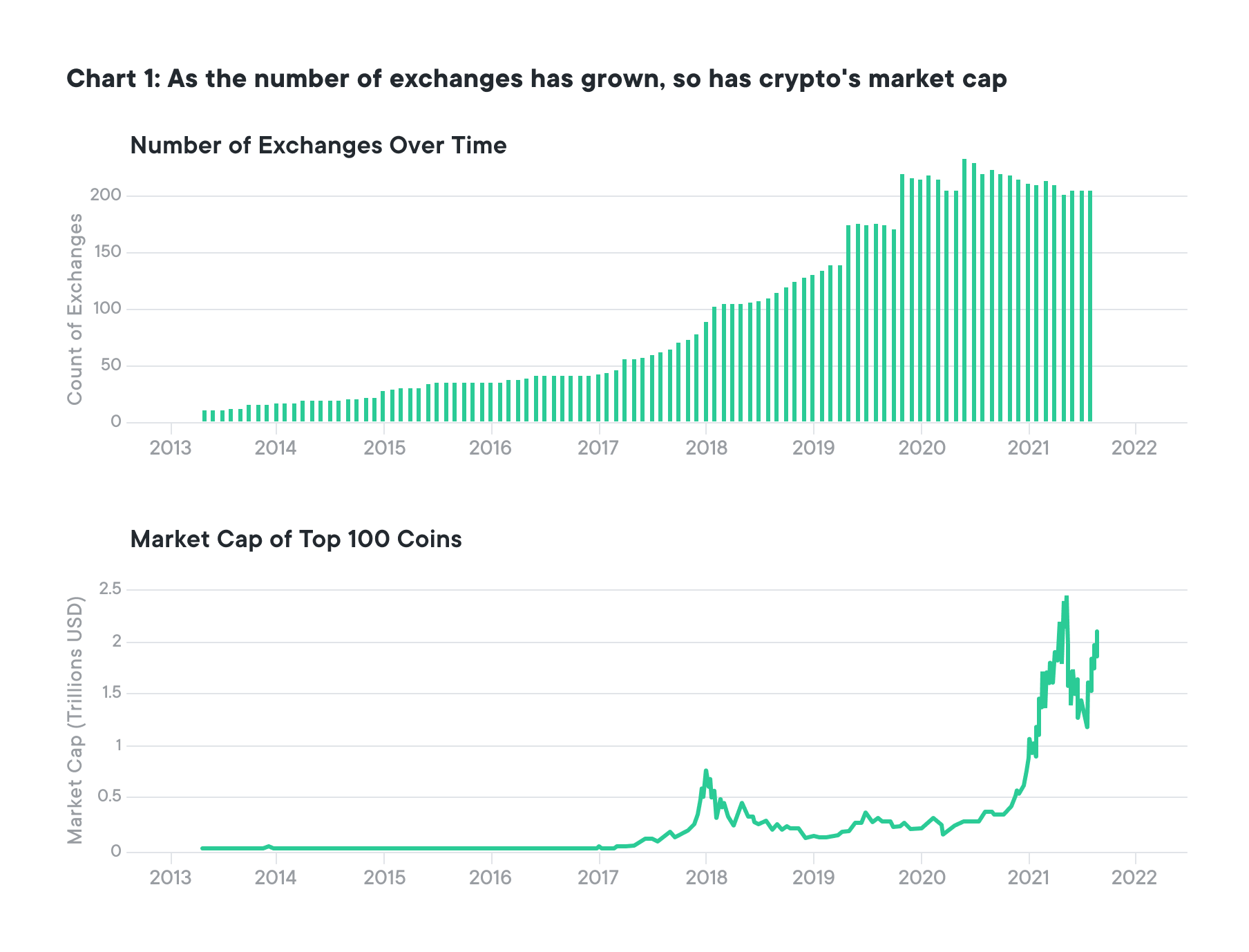
For years (pre-2017), crypto liquidity was limited to a handful of exchanges with a few million dollars in volume across all assets. That’s dramatically changed in the past few years.

Image Credits: Asheesh Birla

Ripple early on focused on the thesis that it will become cheaper to source liquidity for cross-border payments with crypto over traditional fiat if (1) crypto grows in volume around the world (measured by the level of liquidity on exchanges) and (2) you can make bigger payments with it (measured by order book size). What was a lofty vision in 2015 is now reality.

On- and off-ramps are required to access crypto liquidity

A key factor required to use crypto for cross-border payments is easy on- and off-ramps to move from fiat to crypto and vice versa to get access to crypto liquidity. I could once count on one hand the available methods, and today, the different venues, such as stablecoins and exchanges, for moving in and out of crypto are growing quickly. Everyone from the major money transfer companies and card networks to global crypto exchanges is taking advantage of tokenization to address this first hurdle.

Fiat-backed stablecoins have emerged as one of the most popular on- and off-ramps because they ensure a relatively easy way to get access to crypto without having to immediately convert money into fiat when making a payment and therefore eliminating the conversion taxes headache and high volatility in crypto.

This is evident in the growing market cap of stablecoins, which shot up to well over $100 billion in July 2021 from $4 billion in 2019. They provide access and liquidity into crypto exchanges, decentralized finance platforms and less liquid fiat-to-fiat corridors, showing the power of what tokenized assets can do. As the world trends toward tokenizing all kinds of value (fiat, crypto, identity, loans, NFTs, etc.), the more liquidity there is within the system to support moving from one asset to the next.

Getting into the data

Now onto the quantitative reasons — data shows that sourcing liquidity from crypto becomes more cost-effective than fiat over time. The fundamental question is at what data point does sourcing from crypto become consistently cheaper than traditional fiat foreign exchange (FX)?

Using the chart below, we can see how crypto volume, an indicator of liquidity, has grown over the past five years by using five of the top cryptocurrencies by market cap (Bitcoin, Ether, XRP, Litecoin and Bitcoin Cash) on Bitstamp as a proxy for the larger crypto market. These assets combined consistently accounted for about 85% of all crypto volume (outside of stablecoins) from 2016 to 2021.

Image Credits: Asheesh Birla

We specifically looked at USD and EUR monthly volume for the five tokens compared to the USD and EUR average difference in spot and implied FX rates, as well as the USD and EUR order book size from April 2016 to June 2021. Spot rate shows the immediate FX rate at that specific moment in time, while implied rate shows the FX rate achieved from bridging sending currency to destination currency with an intermediary (such as using a crypto asset as the bridge).

As the years passed, the difference between the spot FX rate and the implied rate gets closer to zero, evident from the average trend line, meaning it’s becoming on par or cheaper to send payments through crypto than it is with fiat.

Extrapolating the trend line further, we could forecast the trend line going past zero to a negative difference within the next two years (provided crypto volume continues to double at the current rate). It’s also worth noting other factors at play here, such as that payment providers like PayPal or Western Union charge a fee per fiat transaction (between 0.2%-1% margin).

Image Credits: Asheesh Birla

Over the same time period, the chart above shows how order book size is quickly increasing — meaning there’s enough liquidity to support payments as high as $4 million total in 2021 with these five cryptocurrencies.

Traditional transaction-based payments revenue will become obsolete

To all the money-transfer companies that make a huge chunk of their revenue from FX transaction fees, there should be alarm bells going off when seeing this data.

Here’s the reason why companies are pushing to use crypto for cross-border payments — it’s no longer just about the qualities of blockchain and crypto that make it useful for this use case, but also that global liquidity can truly support these payments at scale. As more options are available for consumers, traditional companies will have to lower transaction fees to keep market share, which will partially mitigate the issues.

To all the consumers that have previously gone to PayPal or the like to make a cross-border payment: Why stick with them when it’s cheaper, faster and just as — if not more — secure to use crypto?

These companies will need to change their revenue models, which currently rely heavily on transaction fees, or risk becoming obsolete. While some are going in the opposite direction (i.e., PayPal has already upped its transaction fees for cross-border merchant payments in Europe, and Western Union is pushing further into digital payments to stave off competitors), the proverbial wave is already crashing down. Other services that they provide (compliance, addressing, etc.) will not save them either — many crypto companies are already implementing robust anti-money-laundering and know your customer (AML/KYC) programs.

While this data using BTC, ETH, XRP, LTC and BCH in a few corridors is a proxy for the entire market, the trend lines are directionally obvious. Crypto is above a $2 trillion market cap today — imagine what could be possible when it’s at $5 trillion or $10 trillion.

Crypto liquidity is changing the game. We’re past the “if” — it’s now onto “when.”

Adblock test (Why?)


Crypto liquidity is ready to eat cross-border payments’ lunch - TechCrunch
Read More

Over 60? This Is The #1 Best Food to Eat, Says Dietitian | Eat This Not That - Eat This, Not That

If anyone has a magic potion to stay young forever, we'll take it now, please! Alright, we get it—there's no magic potion or fountain of youth. According to nutrition experts, there isn't one thing you can do to directly reverse the aging process. However, there are certain superfoods that can help to slow down those inevitable negative effects of aging.

We consulted with Lisa Moskovitz, RD, CEO of NY Nutrition Group, and member of our medical expert board, to find out the best food to include in your diet after your turn 60. And for more anti-aging tips, check out 40 Ways to Stay Healthy After 40, Say Experts.

"Healthy aging requires a balanced diet including a mix of high-fiber carbs, lean proteins, and anti-inflammatory fats," explains Moskovitz. Keeping all that in mind, when asked to select the best choice, Moskovitz recommends wild-caught salmon to keep the mind and body strong after 60.

It's all about the omega-3 fatty acids found in wild-caught salmon that make it the best food to eat, according to Moskovitz. Fighting inflammation, improving heart health, and cognition function all come as a result of a hefty dose of omega-3 fatty acids.

Moskovitz also highlights that "salmon is also a great source of muscle-preserving and collagen-restoring protein, as well as bone-building calcium and vitamin D."

RELATED: Sign up for our newsletter to get anti-aging and health tips in your inbox!

The benefits of adding wild-caught salmon to your diet on a consistent basis can seem to be never-ending thanks to all the nutrients packed in every serving. If you want to get started adding some salmon meals into your diet, but are not exactly sure where to start, we've got you covered with some of our favorite recipes using this seafood superfood.

Salmon isn't the only anti-aging food.

Moskovitz also recommends "replacing refined grains, such as white flour or ultra-processed bread, with whole grains, such as quinoa and brown rice" when it comes to slowing down the aging process.

"Not only do they provide the additional digestion-regulating fiber that can fight through age-related constipation and promote healthy energy levels, but they also pack in additional phytochemicals that protect against oxidative stress, which accelerates the aging process," Moskovitz says.

Looking for some direction once you hit the grocery store? Moskovitz recommends Seeds of Change Organic Quinoa & Brown Rice. It's an easy source of that digestion-relating fiber and phytochemicals, and it's ready to eat in minutes.

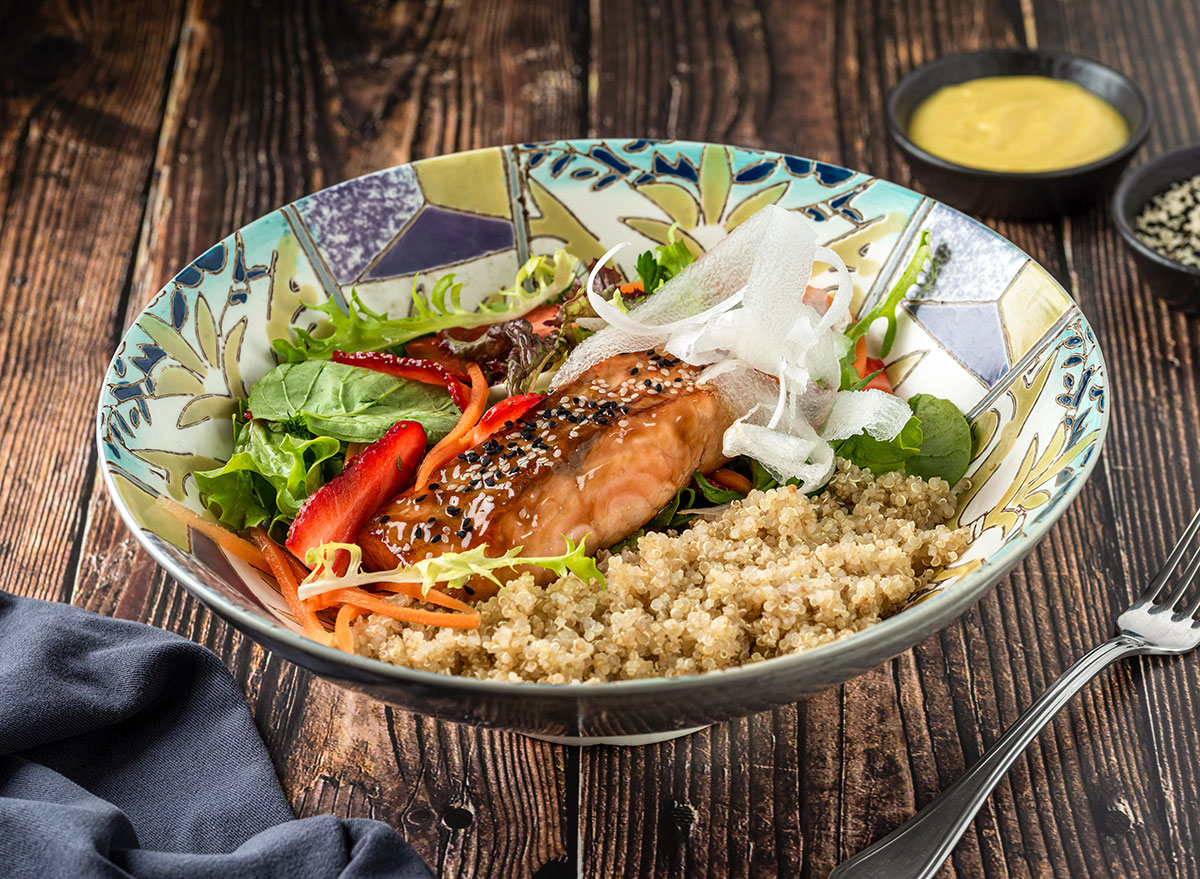
The combination of wild-caught salmon over some quinoa and brown rice sounds like the ideal anti-aging meal—not to mention delicious and filling, too.

For even more healthy eating tips, read these next:

Adblock test (Why?)


Over 60? This Is The #1 Best Food to Eat, Says Dietitian | Eat This Not That - Eat This, Not That
Read More

Can You Eat Chorizo Raw? - Healthline

Anushka Sharma Reveals She Eats Dinner By 6PM With Husband Virat Kohli - NDTV Food

The lives of our favourite celebrities are a source of much curiosity and intrigue among us. We often wonder how these stars stay in such ...